Hexagram 52: Keeping Still, Mountain
Hexagram
52. Keeping Still, Mountain · Gen
Structure of the sign
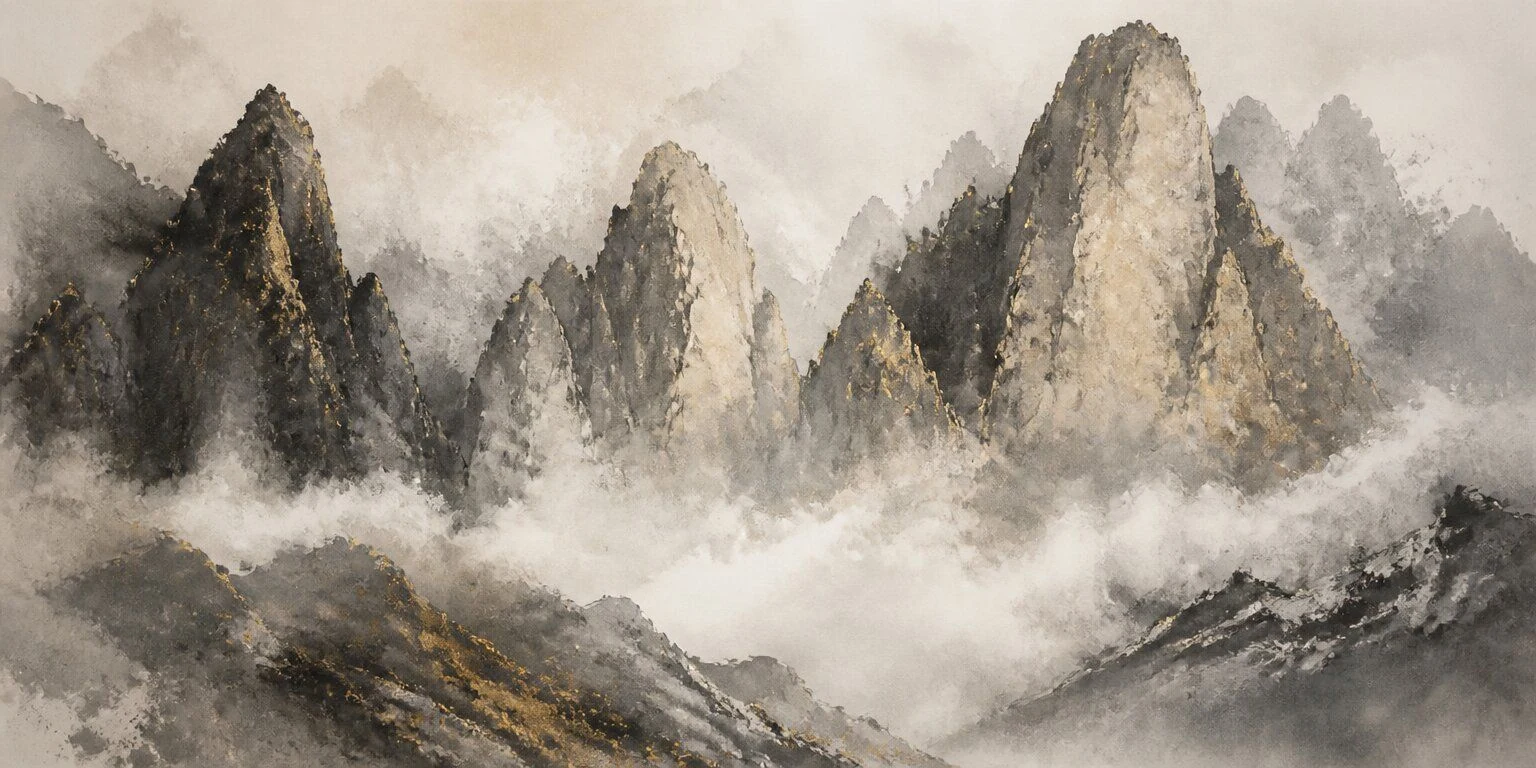
The image of the hexagram is the mountain, the youngest son of heaven and earth. The male is above, whither it strives according to its nature; the female is below, whither the direction of its movement leads. Thus rest is achieved, since movement has attained its normal end. Applied to man, the problem is shown of attaining tranquility of heart. The heart is very difficult to bring to rest. While Buddhism strives for quietude through the fading away of all movement in Nirvana, the standpoint of the Book of Changes is that rest is merely a polar state which constantly has movement as its complement. Perhaps the words of the text contain instructions for the practice of yoga.
The Judgment
Keeping his back still, so that he no longer feels his body. He goes into his courtyard and does not see his people. No blame. True quiet means keeping still when the time has come to keep still, and going forward when the time has come to go forward. In this way rest and movement are in harmony with the demands of the time, and thus there is light in life. The hexagram represents the end and the beginning of all movement. The back is mentioned because all the nerve pathways that transmit movement are situated in the spine. If the movement of these spinal nerves is brought to a standstill, the ego, with its restlessness, disappears as it were. When a man has thus become inwardly calm, he may turn to the outside world. He no longer sees in it the struggle and turmoil of individual beings, and therefore possesses true peace, such as is necessary to understand the great laws of universal happenings and to act in accordance with them. Whoever acts out of this depth makes no mistake.
The Image
Mountains standing together: the image of Keeping Still. Thus the superior man does not permit his thoughts to go beyond his situation. The heart thinks constantly. This cannot be altered. But the movements of the heart, that is, the thoughts, should restrict themselves to the present situation in life. All thinking beyond this only wounds the heart.
The lines
Line 1
Keeping his toes still. No blame. Constant perseverance furthers. Keeping the toes quiet means coming to a standstill before one has even begun to move. The beginning is the time when few mistakes are made. One is still in accord with original innocence. One sees things intuitively as they are, still unclouded by interests and desires. He who halts at the beginning, so long as he has not yet departed from the truth, finds what is right. Only lasting steadfastness is required, so that one does not lapse into drifting without a will.
Line 2
Keeping his calves still. He cannot rescue him whom he follows. His heart is not glad. The leg cannot move independently, but depends in its movement upon the movement of the body. When the body is in strong motion and the leg is suddenly stopped, the continuing movement of the body causes the man to fall. So it is also with a man who is in the following of a stronger personality. He is swept along. Even if he halts upon the path of wrongdoing, he can no longer check the other in his strong movement. Where the master presses forward, the servant, no matter how good his intentions, cannot save him.
Line 3
Keeping his hips still. Making his sacrum stiff. Dangerous. The heart suffocates. This refers to forced quietude. The heart, which is in unrest, is to be subdued by violence. But fire that is forcibly suppressed turns into acrid smoke that suffocates as it spreads. In exercises of meditation and concentration, one must therefore not proceed by force. Rather, quietude must develop quite naturally out of a state of inner composure. If rest is to be compelled through artificial stiffening, meditation will lead to grave disorders.
Line 4
Keeping his trunk still. No blame. Keeping the back still, as mentioned in the words on the hexagram as a whole, means forgetting the ego. This is the highest stage of quietude. Here this stage of quietude has not yet been reached. One is indeed already able to hold still the ego with its thoughts and impulses. Yet one is not entirely free of them. Nevertheless, keeping the heart still is an important function that in time leads to the complete elimination of egotistical drives. Even though one does not remain free from all dangers of doubt and restlessness, this attitude of mind, lying on the way to that other, higher state, is not an error.
Line 5
Keeping his jaws still. The words have order. Remorse disappears. In a dangerous situation, especially so long as one is not equal to it, one is very easily given to chatter and forward jesting. But through indiscreet talk one easily enters into situations where there is afterwards much to regret. However, if one exercises restraint in speech, one's words take on a firmer form, and then every occasion for remorse vanishes.
Line 6▶ ruling line
Noble-hearted keeping still. Good fortune! Here the consummation of the effort toward quietude is attained. One is not quiet in a petty, narrow, piecemeal manner; rather, a general resignation as a whole brings quietude and salvation for every individual thing.
Below ☶ Mountain (Gen)
- Direction
- NE
- Element
- Mountain · Stone
- Attributes
- Keeping Still · Firm · Immovable · Setting Boundaries
- Family
- Youngest Son
Above ☶ Mountain (Gen)
- Direction
- NE
- Element
- Mountain · Stone
- Attributes
- Keeping Still · Firm · Immovable · Setting Boundaries
- Family
- Youngest Son