Hexagram 4: Youthful Folly
Hexagram
4. Youthful Folly · Mong
Structure of the sign
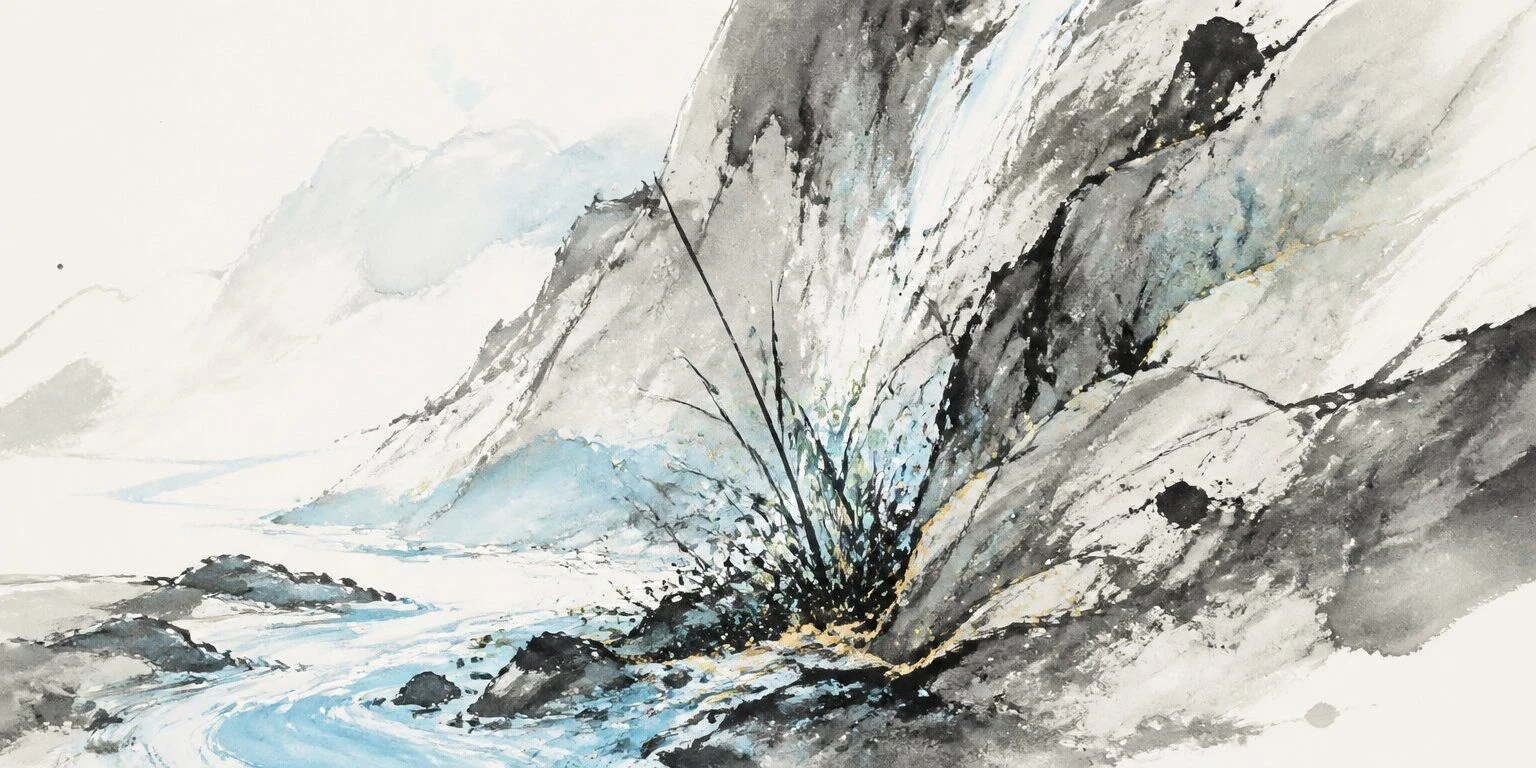
In this hexagram the idea of youth and folly is suggested in two ways. The upper trigram, Gen, has the image of a mountain; the lower, Kan, has the image of water. A spring bubbling up at the foot of the mountain is the image of inexperienced youth. The attribute of the upper trigram is keeping still, that of the lower is the abyss, danger. Pausing in standstill before a dangerous abyss is likewise a symbol of the perplexed folly of youth. But in the two trigrams also lies the way by which youthful follies can be overcome: water is something that of necessity flows on. When the spring gushes forth, it does not know at first, to be sure, whither it will go. But through its steady flow it fills up the deep place that hinders its progress, and then success is won.
The Judgment
Youthful folly has success. It is not I who seek the young fool; the young fool seeks me. At the first oracle I inform him. If he asks two or three times, it is importunity. If he importunes, I give no information. Perseverance furthers. In youth, folly is nothing bad. Success may yet be attained. One need only find an experienced teacher and approach him in the right way. This requires first of all that one feels one's own inexperience and seeks out a teacher. Only this modesty and this interest guarantee the necessary receptivity, which will express itself in respectful recognition of the teacher. Therefore the teacher must wait quietly until he is sought out. He should not offer himself of his own accord: only thus can instruction take place at the right time and in the right way. The answer that the teacher gives to the pupil's questions should be clear and definite, like the answer an oracle-seeker desires to receive. It must then be accepted as a solution of doubt and a decision. Distrustful or thoughtless further questioning serves only to importune the teacher, and is best met with silence, just as the oracle gives only one answer and refuses to respond to tempting questions of doubt. If to this is added the perseverance that does not slacken until one has mastered the material point by point, a fine success will be certain. The hexagram thus gives counsel both to the one who teaches and to the one who learns.
The Image
A spring wells up at the foot of the mountain: the image of youth. Thus the superior man fosters his character by thoroughness in all that he does. The spring comes into flow and overcomes stagnation by filling all the hollow places in its path. In the same way, the road to character building is thoroughness, which skips nothing, but gradually and steadily fills all the gaps like water and thus moves forward.
The lines
Line 1
To develop the fool, it is furthering to discipline the man. One should take off the fetters. To go on like this brings humiliation. At the beginning of education stands the law. Inexperienced youth is inclined at first to take everything carelessly and playfully. There the seriousness of life must be shown to it. A certain pulling oneself together, where it is enforced by strict discipline, is good. He who plays with life never accomplishes anything. But discipline must not degenerate into drill. Continued drill has a humiliating effect and paralyzes strength.
Line 2▶ ruling line
To bear with fools in mildness brings good fortune. Knowing how to deal with women brings good fortune. The son is capable of managing the household. Here a man is portrayed who has no external power, but the necessary spiritual strength to bear the responsibility weighing upon him. He possesses the inner superiority and strength that knows how to bear the inadequacies of human folly with mildness. The same attitude applies toward women as the weaker sex. One must know how to deal with them and acknowledge them with a certain chivalrous forbearance. Only through this union of inner strength and outer restraint will one be able to assume the responsibility of guiding a larger social organism and thereby achieve real success.
Line 3
You should not take a girl who sees a man of bronze and does not keep possession of herself. Nothing is furthering. A weak, inexperienced person who strives upward easily loses his personal individuality when he sees a strong personality in a high station whom he slavishly imitates. He is like a girl who throws herself away when she meets a strong man. Toward such an unfree approach one must not be receptive. Encouragement would be good neither for the youth nor for the educator. A girl owes it to her dignity to wait until she is wooed. In both cases it is unworthy to offer oneself, and it is not good to accept such an offer.
Line 4
Entangled folly brings humiliation. For youthful folly, the most hopeless thing is to become entangled in empty conceits. The more obstinately it clings to such unreal conceits, the more surely does it draw humiliation upon itself. Toward entangled folly, the educator will often have no choice but to leave it to itself for a time and not spare it the humiliation arising from its conduct. This is often the only way to rescue it.
Line 5▶ ruling line
Childlike folly brings good fortune. An inexperienced person who seeks instruction childlike and without pretension is in a fortunate position. For he who, free from pride, places himself under the guidance of the teacher will surely be furthered.
Line 6
In punishing folly, it is not furthering to commit excesses. It is furthering only to ward off excesses. Under certain circumstances an incorrigible fool must be punished. He who will not hear must feel. This punishment is different from the shaking up at the beginning. But the infliction of punishment must not take place in anger, but must be limited to an objective defense against unjustified transgressions. It is never an end in itself, but must serve only to establish orderly conditions. This applies both to education and to the measures taken by a government against a population guilty of excesses. The intervention of the government must always be merely defensive and have as its sole aim the establishment of public security and peace.
Below ☵ Water (Kan)
- Direction
- N
- Element
- Water · Moon
- Attributes
- Abysmal · Dangerous · Penetrating · Profound
- Family
- Middle Son
Above ☶ Mountain (Gen)
- Direction
- NE
- Element
- Mountain · Stone
- Attributes
- Keeping Still · Firm · Immovable · Setting Boundaries
- Family
- Youngest Son