Hexagram 48: The Well
Hexagram
48. The Well · Jing
Structure of the sign
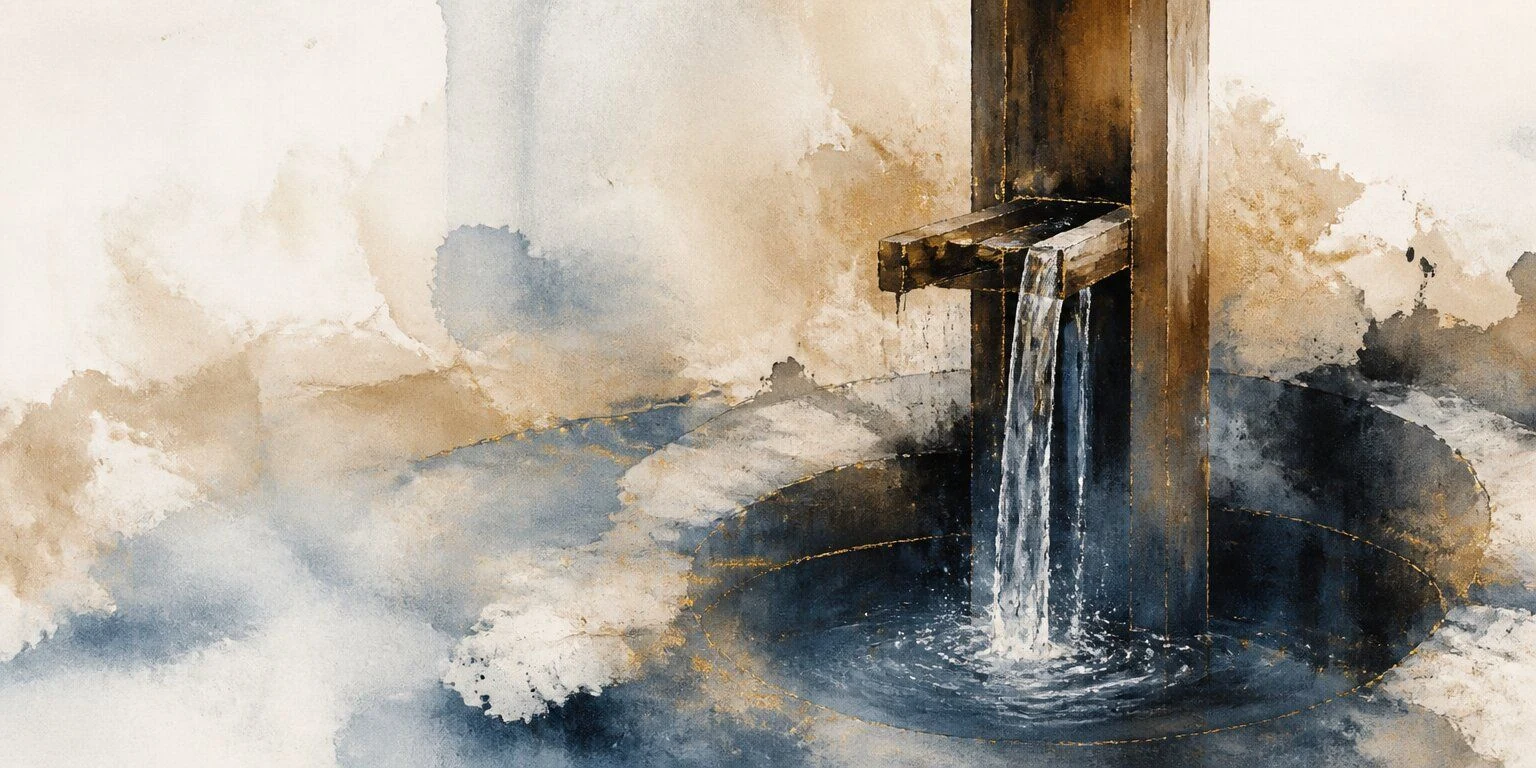
Below is wood, above is water. The wood goes down into the earth to draw up the water. It is the image of the ancient Chinese sweep-well. By wood are not meant the buckets, which in ancient times were of earthenware, but the wooden pole through whose movement the water is lifted from the well. The image also points to the plant kingdom, which draws up water from the earth through its vessels. Furthermore, the well from which water is drawn contains the idea of an inexhaustible dispenser of nourishment.
The Judgment
The Well. One may change the city, but one cannot change the well. It neither decreases nor increases. They come and go and draw from the well. If one has almost reached the water of the well, but the rope has not yet reached the bottom, or one breaks his jar, this brings misfortune. In ancient China, capitals were sometimes moved, partly for reasons of favorable location, partly at the change of dynasties. The architectural style changed over the centuries, but the form of the well has remained the same from primordial times down to the present day. Thus the well is an image of the social organization of humanity in its most primitive necessities of life, independent of all political configurations. Political configurations and nations change, but the life of human beings with its requirements remains eternally the same. That cannot be changed. This life is also inexhaustible. It neither diminishes nor increases, and it is there for all. Generations come and go, and they all enjoy life in its inexhaustible abundance. For a sound political or social organization of humanity, however, two things are necessary. One must go down to the very foundations of life. Any superficiality in the order of life that leaves the deepest human needs unsatisfied is just as defective as if no attempt at order had been made at all. In the same way, carelessness through which the jar is broken brings evil. If, for example, the military protection of a state is so exaggerated as to provoke wars through which the state's power is destroyed, that is a breaking of the jar. The sign also has reference to the individual person. However different the talents and educations of human beings may be, human nature at its foundation is the same in everyone. And each person, in his cultivation, can draw from the inexhaustible fountainhead of the divine nature of the human essence. But here too, two dangers threaten: first, that in one's cultivation one fails to penetrate to the real roots of humanity and remains entangled in convention—such half-culture is as bad as uncultivated ignorance—or that one suddenly collapses and neglects the cultivation of his being.
The Image
Water over wood: the image of the Well. Thus the superior man encourages the people at their work and exhorts them to help one another. Below is the sign Sun, wood; above it is the sign Kan, water. The wood draws the water upward. Just as wood as an organism imitates the activity of the well, which benefits all parts of the plant, so the superior man orders human society so that, like a plant organism, it interlocks for the well-being of the whole.
The lines
Line 1
One does not drink the mud of the well. No animals come to an old well. If someone loiters about in marshy lowlands, his life sinks into the mud. Such a person loses his significance for humanity. He who throws himself away is no longer visited by others. In the end, no one cares for him any longer.
Line 2
At the well hole one shoots fishes. The jar is broken and leaks. The water in itself is clear, but it is not used. Thus only fish stay in the well, and whoever comes, comes only to catch fish; but the jar is broken, so that one cannot keep the fish in it. A situation is described in which someone has good talents in himself, but they are neglected. No one concerns himself with him. As a result, he deteriorates inwardly. He associates with vulgar people and can no longer accomplish anything worthy.
Line 3
The well is cleaned out, but one does not drink from it. This is my heart's sorrow, for one could draw from it. If the king were clear, one might enjoy good fortune together. Here an able man is present. He is like a cleaned well whose water could be drunk. But he is not used. That is the grief of the people who know him. The wish is that the prince might learn of it; then it would be a blessing for all concerned.
Line 4
The well is being lined with stone; no blame. When the well is being lined, one cannot use it for that duration, but the work is not in vain; it ensures that the water remains clear. So too in life there are times when one must put oneself in order. During this time one can accomplish nothing for others, but it is nonetheless valuable because, through inner cultivation, one increases one's strength and capacities, so that afterward one accomplishes all the more.
Line 5▶ ruling line
In the well is a clear, cold spring from which one can drink. This is a good well that has a spring of living water at its bottom. A man who possesses such virtues is born to be a savior and leader of men. He has the water of life. Yet the omen 'good fortune' is missing. With the well, everything depends on the water being drawn. The finest water exists for the refreshment of people only as a possibility as long as it is not brought up. So too with the leaders of mankind: everything depends on men drinking from their spring and putting their words into practice.
Line 6
One draws from the well without hindrance. It is dependable. Supreme good fortune! The well is there for everyone. No prohibition hinders those who draw. Yet however many come, they find what they need, for the well is reliable. It has a spring and does not run dry; therefore it is a great blessing for the entire land. So it is with the truly great man who is inexhaustibly rich in inner treasures. The more people draw from him, the greater his wealth becomes.
Below ☴ Wind (Sun)
- Direction
- SE
- Element
- Wood · Wind
- Attributes
- Gentle · Penetrating · Gradual · Persevering
- Family
- Eldest Daughter
Above ☵ Water (Kan)
- Direction
- N
- Element
- Water · Moon
- Attributes
- Abysmal · Dangerous · Penetrating · Profound
- Family
- Middle Son